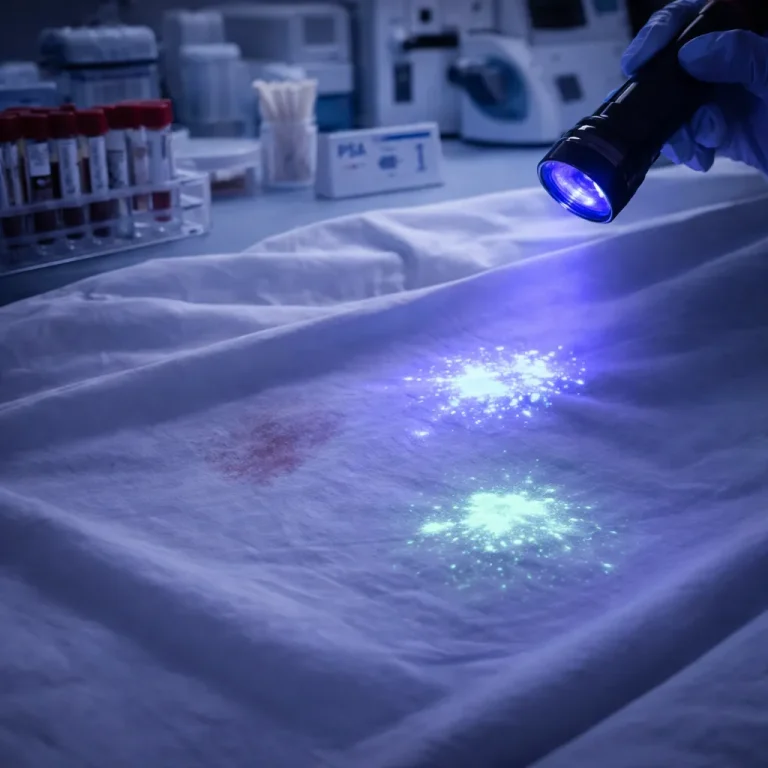
About the Fluid Identification Test
When stains are detected on a garment or any other support, it is essential to determine their nature, since different methods of analysis will be applied depending on the type of fluid.
Biological fluids that we analyze most frequently

Blood
The presence of a reddish stain does not necessarily imply that it is blood, as it may correspond to traces of food (such as tomato or cherry), dyes or other substances.
For this reason, specific tests are carried out to confirm whether the stain really corresponds to human blood, which is particularly relevant in the field of forensic investigation.

Semen
In cases of alleged sexual assault or in private investigations, it may be important to determine whether a stain found on clothing or other objects is semen.
In our laboratory we analyze the presence of prostate specific antigen (PSA), a glycoprotein produced by the prostate and present in seminal plasma. This marker allows us to detect semen even in situations where the male has undergone vasectomy.

Saliva
Saliva can be found on objects such as cigarette butts, glasses, bottles, envelopes, chewing gum or bites.
Specific tests can be used to detect the presence of saliva. If necessary, DNA can also be extracted from the cells of the buccal mucosa that are usually deposited with the saliva, allowing a genetic profile to be obtained for comparison.
What kind of samples can be analyzed?
In our laboratory we can analyze stains or biological remains present on different types of objects or surfaces, for example:
- underwear
- linens or clothing
- cigarette butts
- chewing gum
- glasses or bottles
- envelopes or stamps
- condoms
- handkerchiefs or fabrics with biological stains
Each case is evaluated individually to determine the feasibility of the analysis and the most appropriate type of test.
FAQs
Frequently asked questions about
Fluid Identification
What types of biological fluids can be analyzed?
In our laboratory we perform analyses to detect blood, semen and saliva on different surfaces and materials such as clothing, bed linen, cigarette butts, glasses, chewing gum or other objects that may contain biological remains.
Is it possible to analyze old stains or stains that have been washed out?
In many cases, yes. Although washing or the passage of time can degrade biological samples, it is often still possible to detect the presence of fluid or even recover genetic material if sufficient cells remain in the sample.
What happens if the presence of a biological fluid is confirmed?
If the presence of a biological fluid is confirmed, in some cases it is possible to perform a DNA extraction from the cells present in the sample to try to obtain a genetic profile that can be compared with that of other individuals.
However, the detection of a fluid does not always guarantee that a valid DNA profile can be obtained. For example, in the case of semen, the initial analysis detects prostate-specific antigen (PSA), a protein present in seminal plasma that can be preserved even when DNA is degraded or in very low amounts.
For this reason, it may happen that the presence of the biological fluid is confirmed but it is not possible to obtain a usable genetic profile for comparison.
Does saliva contain DNA?
Saliva itself contains very little DNA. However, it often carries cells from the buccal mucosa shed from the mouth, which do contain genetic material. These cells make it possible, in many cases, to obtain a DNA profile for analysis.
How long can semen, blood or saliva be detected on a garment?
The time during which a biological fluid can be detected depends on several factors, such as the storage conditions of the garment, exposure to humidity, temperature, light or washing.
In general, if the garment has been kept in relatively stable conditions, biological remains may remain detectable for long periods of time, even after weeks, months or longer.
However, over time or after several washes, the fluids may degrade or reduce in quantity, which can make detection or subsequent DNA collection difficult.
For this reason, each sample must be evaluated individually to determine the feasibility of the analysis.
Do you need help with your case?
Consult your case with our specialists and we will prepare a detailed, bespoke quote for you. Our team will be happy to assist you.
We can provide fast, confidential, and personalized advice so that you can carry out your paternity test with complete peace of mind.
Contact us and we will inform you without obligation